
Most enterprise governance stacks can map every table, pipeline, and dashboard inside the warehouse. Then an auditor points at a competitive pricing feed and asks where the numbers came from, and the answer dies at the ingestion boundary: "a vendor sends us a file."
That gap is what data governance in web scraping exists to close. Scraped data enters your stack from outside the governed perimeter, which means the provenance, audit evidence, and documentation your governance program depends on either get captured at collection or they don't exist at all.
Here's a quick test. Pick any scraped value in one of your dashboards, say a competitor's price, and try to answer these four questions:
- Which URL did it come from?
- When exactly was it collected?
- Which scraper version and configuration captured it?
- What transformations happened between the source page and your warehouse?
If any answer is "we'd have to ask the vendor" or "someone would have to dig," this article is for you. It covers the three pillars that make scraped data governable, what each one must capture in a scraping context, and how to build them into operations rather than bolting them on after the first audit scare.
What Does Data Governance Mean for Web Scraping?
Data governance is the set of policies, processes, and evidence that let an organization treat data as a managed asset: known origin, controlled access, verified quality, defensible use. For internal data, modern tooling handles much of this automatically. Scraped data breaks the model.
The governed perimeter problem
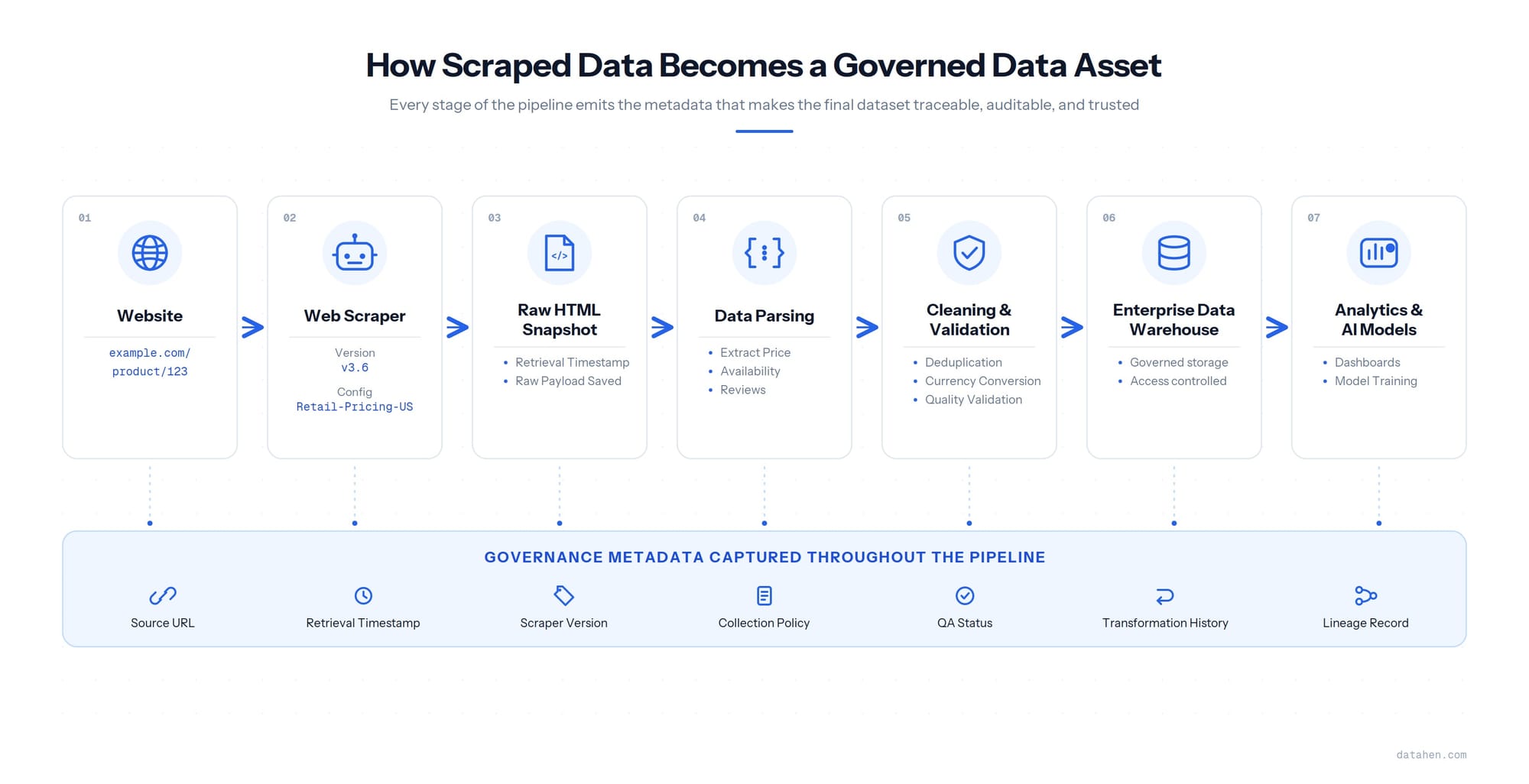
Catalogs, lineage tools, and access controls typically begin working the moment data lands in your warehouse. Everything upstream of that landing happens outside their view:
- Which site was scraped, and which specific pages
- When each page was retrieved
- What scraper version and settings did the collecting
- What collection policy the run operated under
If the scraping operation doesn't record that context itself, your governance program inherits a dataset with no history, and no amount of downstream tooling can recover it. Unlike an internal system, you cannot go back and ask last month's version of a website what it said.
The stakes of that blind spot are familiar by now: Gartner puts the average annual cost of poor data quality at $12.9 million, and ungoverned external data is one of the quieter ways those costs accumulate, because errors with no traceable origin take the longest to find.
The three pillars: lineage, audit trails, documentation
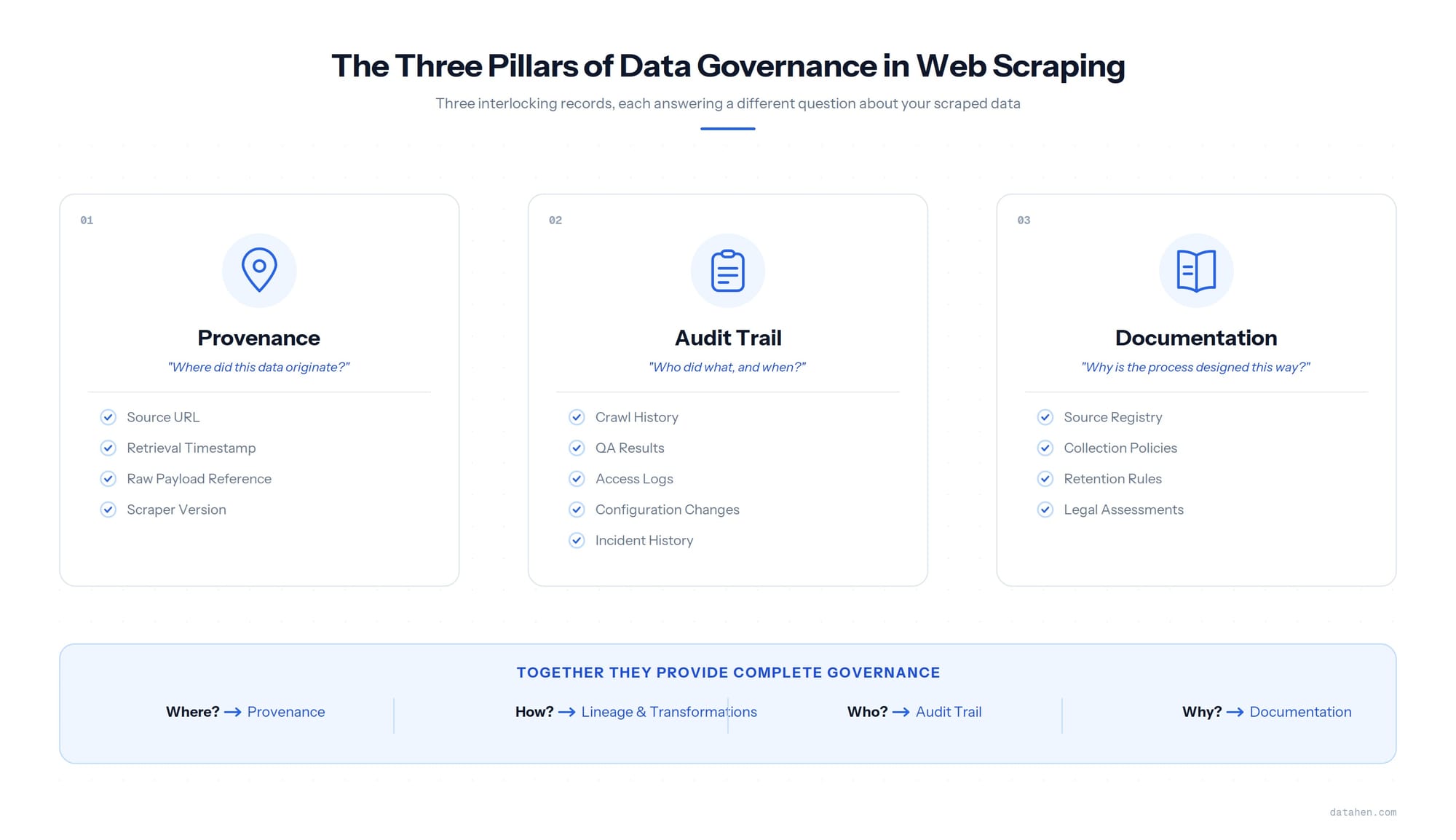
In practice, governing scraped data comes down to three interlocking records, each answering a different question:
| Governance component | Question it answers | Example |
|---|---|---|
| Provenance | Where did this data originate? | Collected from example.com/product/123 at 10:42 UTC |
| Lineage | How did it change on the way here? | Parsed, deduplicated, converted USD to CAD |
| Audit trail | Who and what acted on it, and when? | Crawl #4812 ran at 09:00, QA passed, analyst X downloaded the file |
| Documentation | Why is the operation designed this way? | Source registry, collection policy, retention rules |
Strong lineage is widely treated as the cornerstone of the whole framework, because it's what gives governance programs accountability, quality tracing, and a usable audit trail for regulations like GDPR. The rest of this article takes the pillars one at a time.
Provenance and Lineage for Scraped Data: Tracking Origin From the First Request
Lineage answers the question every stakeholder eventually asks: where does this value come from? For scraped data, a complete answer looks like a chain you can walk end to end. Take that competitor price from the intro:
$39.99 in your dashboard
   ↑ published to warehouse         2025-04-12 11:03 UTC
   ↑ currency converted             USD → CAD (rate snapshot attached)
   ↑ deduplicated and validated     QA run #4812, passed
   ↑ parsed by scraper              v3.6, config "retail-pricing-us"
   ↑ collected from                 example.com/product/123
   ↑ retrieved at                   2025-04-12 10:42 UTC
Every hop in that chain is recorded metadata, not institutional memory. That's the standard the rest of this section unpacks.
Lineage vs. provenance, and why scraped data needs both
The two terms get used interchangeably, but the distinction matters for scraping:
| Provenance | Lineage | |
|---|---|---|
| Records | The origin: source URL, capture moment | The journey: every transformation after capture |
| Answers | "Where was this born?" | "How did it change?" |
| Hard part for scraping | The source is external and keeps no record of what it showed you | Transformations span vendor and internal pipelines |
Internal data mostly needs lineage, since its origin is a known system. Scraped data needs both, and provenance is the harder half, because it can only be captured in the moment of collection.
What scraped-data lineage must capture
A governable scraping pipeline attaches metadata to every record at extraction time:
- Source URL and retrieval timestamp
- Scraper version and configuration
- The collection policy the run operated under
- A reference to the raw payload
From there, standard lineage takes over: each parsing rule, each of the data cleaning steps applied, and each merge with other sources gets recorded as a transformation the final value can be traced back through. The test is the four-question quiz from the intro. If a value passes, you have lineage. If the trail ends at "the March file," you have a liability.
Field-level lineage and downstream trust
Granularity matters. Dataset-level lineage ("this table came from these five sites") satisfies almost nobody, because the questions that carry business or regulatory weight are field-level: which source feeds the price column, which fields contain personal data, which values were transformed versus captured raw. Field-level lineage is what lets a downstream team trust one column while investigating another, and it's what turns a compliance review from an archaeology project into a query.

Audit Trails: Proving What Happened, Not Just What Flowed
Lineage maps the data's journey. Audit trails prove the operational story around it, and the two are complementary rather than interchangeable. Lineage answers "where does this value come from?" while an audit trail answers "who did what, when?", and logs that track user actions say nothing about the substance of the data itself. A governance program needs both, because auditors ask both kinds of question.
What a scraping audit trail contains
For a scraping operation, the audit trail records the runs and the hands:
- When each crawl executed, and against what target list
- Which quality checks ran, and what they found
- Who accessed the delivered datasets, and when
- Who changed a scraper's configuration, and why
- What happened during incidents: detection, root cause, backfill
This is also where reliability and governance converge, since the monitoring and recovery processes that catch broken scrapers generate exactly this run-level evidence. A gap in the data with a documented incident attached is an explained event. The same gap with no record is a credibility problem.
Evidence as a byproduct, not a reconstruction exercise
The standard worth adopting comes from mature governance practice: an audit process should make evidence generation a byproduct of normal operations, because if teams have to manually piece together access decisions, lineage paths, and exceptions before every audit, the process isn't producing the records it needs.
The practical implication for scraping: logging, quality reports, and access records should be emitted automatically by the pipeline, not assembled by an engineer the week before an audit. Reconstruction is exactly the kind of work that helps explain why data engineers already spend roughly 40% of their time dealing with bad data. Governance done as a byproduct returns that time.
Documentation: The Governance Layer Auditors Actually Read
Lineage and audit trails are machine-generated evidence. Documentation is the human layer that explains why the operation looks the way it does, and it's usually the first thing a reviewer requests.
The scraped-data documentation set
A defensible scraping program maintains a small, current document set:
| Document | What it contains |
|---|---|
| Source registry | Every target site, its review status, data categories, known constraints |
| Collection policies | What may be gathered per source; exclusions for personal and sensitive data |
| Retention and deletion policy | How long scraped data lives, and how it's destroyed |
| Legal assessments | Legitimate interest assessments and DPIAs, where personal data is in scope |
None of these documents is long. Their absence, however, is loud.
Change documentation: schemas, sources, and scraper versions
Scraping operations change constantly, because the web changes constantly, so the documentation has to version. Schema changes, new sources, retired sources, and scraper modifications should each leave a dated record with a reason attached.
This is what makes point-in-time questions answerable: not just "where does this field come from?" but "where did it come from last March, before the source redesign?" Historical datasets are only as trustworthy as your ability to reconstruct the context they were collected under.
Why Scraped Data Raises the Governance Bar
Two forces are turning scraped-data governance from good practice into a requirement.
Regulatory drivers: GDPR and the EU AI Act
Privacy regulation was the first driver. GDPR's documentation requirements make records of lawful basis, minimization measures, and retention central to defensibility when scraping touches personal data, and demonstrating those safeguards requires exactly the lineage and documentation described above.
AI regulation is the second wave: regulators increasingly expect point-in-time views of how data was sourced and transformed, and the EU AI Act's requirements on data governance and traceability for high-risk systems carry fines ranging from €7.5 million to €35 million. Both regimes converge on the same demand: show the journey, with evidence.
AI training data makes provenance non-negotiable
If scraped data feeds models, the governance bar rises again, because model training bakes data in. Organizations that skip provenance tracking discover they can't comply with right-to-be-forgotten requests, because they can't trace which records contain a specific person's data, which is why mature AI governance treats every data asset as needing a lineage record documenting its origin, creation method, and applicable policies.
For enterprises buying scraped datasets for AI use, provenance isn't metadata hygiene; it's the difference between a correctable dataset and a model you may have to retrain from scratch. This is also where governance meets the security and compliance verification you should already be running on any data vendor.
How Do You Implement Data Governance in Web Scraping Operations?
The principles compress into three operating rules.
Capture at collection, because you can't reconstruct it later
This is the rule everything else hangs on. Source URLs, timestamps, scraper versions, and policy context must be attached when the request is made, since the external web offers no second chance to collect them. Retrofitting governance onto an existing scraped archive means accepting that its history is permanently incomplete. New pipelines should treat provenance metadata as part of the schema, not an optional extra.
Automate lineage capture and quality evidence
Manual tracking fails at scraping scale, and not gracefully: manual lineage depends on tribal knowledge that leaves with employee turnover, creates delays when teams reconstruct lineage during incidents, and produces outdated diagrams that give false confidence. The scraping pipeline itself should emit lineage records, quality-check results, and run logs automatically, so the evidence exists whether or not anyone remembered to write it down. Automation is also what keeps governance current as sources and schemas change weekly.
What to demand from your scraping vendor
If a vendor collects your data, their governance is your governance, so make it inspectable. In vendor conversations, ask:
- What provenance metadata comes attached to each delivery?
- Does a QA report accompany every batch?
- How are source and schema changes communicated, and how far in advance?
- What documentation supports personal-data handling?
Then make the answers contractual through SLA commitments: delivery metadata, quality reporting, and change notification are all enforceable terms. A vendor who delivers bare CSVs with no lineage is handing you data your own governance program can't stand behind.
Conclusion
Governed scraped data comes down to three records kept honestly: lineage that traces every value to a source page and time, audit trails generated as a byproduct of operations rather than reconstructed under pressure, and documentation that explains the policies behind the collection. The unifying principle is capture at collection, because scraped data's history exists for exactly one moment, and either your pipeline records it or nobody does. Enterprises that build this in stop fearing the "where did this come from?" question. It becomes a query, not a crisis.
DataHen delivers scraped datasets with the governance layer included: provenance metadata, QA reporting with each batch, documented collection policies, and change notifications built into managed pipelines. If your governance or compliance team has questions your current data feeds can't answer, request a quote and tell us what you need to prove.
Frequently Asked Questions
Q: What is data governance in web scraping?
It's the set of practices that make scraped data traceable, auditable, and documented: recording where every value came from (provenance and lineage), keeping evidence of collection runs, quality checks, and access (audit trails), and maintaining the policies behind the operation (documentation). Because scraped data originates outside your systems, this context must be captured at collection or it's lost permanently.
Q: What is the difference between data lineage and data provenance?
Provenance records origin: the specific source, such as a URL, and the moment of capture. Lineage records the journey after origin: every transformation, cleaning step, and merge between the source and the final dataset. For internal data the origin is a known system, so lineage dominates. For scraped data, provenance is equally critical, because the external source keeps no record of what it showed you.
Q: What is the difference between data lineage and an audit trail?
Lineage traces the data's path and transformations, answering "where does this value come from?" An audit trail records actions and actors, answering "who did what, and when?" They're complementary: lineage can show a price field came from a retailer's site, while the audit trail shows which crawl collected it, which quality checks it passed, and who accessed the delivered file. Governance reviews typically require both.
Q: What metadata should be captured for scraped data?
At minimum: the source URL, retrieval timestamp, scraper version and configuration, the collection policy in force, and a reference to the raw payload. Downstream, each transformation should be recorded so values remain traceable at the field level. Capturing this at extraction time is essential, since none of it can be reconstructed after the fact.
Q: Why does AI training data need lineage and provenance?
Because training bakes data into models. Without provenance, you can't identify which records contain a specific person's data for deletion requests, can't demonstrate lawful sourcing to regulators, and can't remediate a contaminated dataset without retraining from scratch. AI regulation, including the EU AI Act's traceability requirements for high-risk systems, is turning training-data provenance into a legal obligation rather than a best practice.
Q: Who is responsible for data governance when using a web scraping vendor?
Accountability stays with your organization, since you're typically the data controller and the party auditors and regulators will question. The vendor's role is to make governance possible: delivering provenance metadata, quality evidence, and documentation with the data. That's why governance capabilities belong in vendor due diligence and contracts, because a vendor who can't supply the evidence leaves you unable to answer for your own data.